Taming the Utopia
"the unknown masterpiece"
By using this frequently invoked terminus technicus, we are playing a ‘hazardous game’. Unless we are prepared, at all costs, to identify ourselves with the historical ‘intermezzo’ of utopian, visionary regions – admittedly the most decisive feature of the ‘exhibition’ and the principal source of its ‘virtues’ – we remain dependent on importing art created by today’s ‘great artists’, often simply because of the unavoidability of international canonisation mechanisms. On the other hand, this seems to be the only legitimate, viable way of increasing visitor numbers and overcoming the aversion and disinterest bred by obscurity.
But what happens if we do, to some extent, obey the ‘postcolonial’ fashion waves of international trends, and try to smuggle in something from outside the tried-and-tested coordinate systems of contemporary art production – from the heterotopic field of a yet non-existent discourse?
‘Yona Friedman exhibition’, says the inviting title of the exhibition. Yet after we return, without once having turned our curious gaze towards the first space unit, we do not understand what kind of mysterious rumour invited us, or exactly why. It is unclear, of these two intellectual regions – so far apart from one another in every respect – in which one the idea was born, who took the first steps, and what its intention actually was. These questions come to mind naturally, irrespective of the fact that it is impossible to take in the whole exhibition. What can we do with that ‘strangeness’ if we do not want to exclude the political correctness that provides the unavoidable foundation of our tried-and-tested civilisational self-image, and yet do not wish to get drunk on the arsenal of ‘tactical theology’ either? How will we be able to appreciate something whose circumstances we do not know, except for one: its mere a priori character.
As we know, nowadays an exhibition, regardless of its theme and material, is not introduced by the exhibited works or by the uniformly tedious opening speeches, but by a well-planned, market-oriented marketing campaign. Unfortunately, conceptual mistakes are already visible at these initial steps – mistakes that multiply as the exhibition is realised. Advertising and marketing cannot take into account the unique character arising from the obscurity of its subject, including the possible pitfalls deriving from the receiver’s understandable lack of experience. Unlike the language of cultures, the rhetoric of marketing seems increasingly universal. The language of the marketing mechanism has to be stripped of all the specificities of Friedman’s spirit, so that those seeking to secure a financial return can organise the presumed receiver’s activity into easily graspable formulas.
The exhibition itself tends to reduce the receiver’s activity, far-reachingly, to the passivity of ‘attendance’, to the easy pleasure and exoticism of mere contemplation. As a result, the subject of the exhibition becomes a circus spectacle, offering only the childish experience of inquisitive peeping. By merely displaying the inner strangeness and maladjustment of a culture, and multiplying its inherent decorative effects through ‘incantation’, not many guidelines can be offered to readers, since the exhibition does not engage with their own cultural experience. However, this is not a problem in itself, because the perceptibly forced application of a mere mechanism – decorativity that alienates in itself – should not be taken to suggest the blending of wholly different cultural contents. By stripping away every ‘objectifiable’ possibility of creating interactivity, and cancelling the tangible vivacity of commentary during cognition, we degrade the possible dialogue between cultures to a restricted, gawping stare.
There would have been several opportunities to create, transparently, a yet non-existent discourse, since all of the exhibited objects were born within the immanent everydayness of culture. Of course, the keyword is everydayness, which, by nature, is able to examine itself only within its own frame. Instead, self-marketing as a simulacrum has created merely the illusion and virtual commercialisation of interactivity: the omnipotence of liking and commenting provided by social media.
Exhibition Plan
1. Do not provide any written material, data, information, or documentation on Yona Friedman, neither in the gallery nor anywhere else in the building. Do not present his bio, work, or the history of its influence or his manifestos (or parts of them), nor his credo possibly arising from it.
2. Do not have any documentary or other audio-visual records (not on him, not by him). Do not show any pictures.
3. Do not present quotes (regardless of length) by him or anyone else. No appreciation, no reminiscences.
4. It is quite enough to indicate the following at the gallery’s entrance: Yona Friedman exhibition.
5. Raise the ‘floating wall’ of the ‘Floating City’ (‘Ville Spatiale’) just a few metres from the gallery entrance using the distinctive Friedmanian elements all along the gallery space, piling them up to a certain height so that visitors would not be able to sense depth and distance. Do not make an entrance on the ‘floating wall’. Although it will appear, at first sight, as a static complex, the building parts can be undone and moved in any order.
6. The inner space is not homogeneous but divided by Friedmanian geometrical structures. Depending on the very part of the ‘floating wall’, visitors might enter different spaces. Different parts of the space should not have any function. They should only differ in form and material, evoking Friedman’s concept of aesthetics. Differences should reflect the changes in Friedman’s work and thoughts. In this case, it has a retrospective aspect.
7. Besides, the building parts must not have any practical functions – they have to be – more or less – closed units which, in that way, like the ‘floating wall’, cannot inform visitors about what they might find beyond the actual space unit. The (temporarily) distinct space units cannot be too big; they should evoke a certain claustrophobic feeling.
8. Closed space units do not have an entrance or exit; only visitors can make space units transparent – either for themselves or for others. Building parts can be removed or changed depending on visitors’ decisions. The number and size of space units created by visitors depend only on their own personal decisions.
9. Since all building parts can be removed, changed, or altered during the exhibition, the number of new structures is potentially endless. Pre-defined static building parts and the space units they shape – as a result of the constant interventions of the visitors – cannot act as a reference point either for the shaping of space and establishing aspects or for any defined aesthetic point of view, since the exhibition itself cannot be viewed literally, only through deconstructing it.
10. Do not provide visitors with any pedagogical or didactic help. They cannot receive any support for their activity. They cannot be informed, in writing or verbally; therefore, guidance is not possible either. Not even in this case do they act at all.
11. There are only two usable tools (avoiding didactic elements as much as possible; the less information is given, the more it makes visitors tell about themselves).
a. A simple paperboard sheet on the wall next to the gallery entrance without frame, ornamentation, or embellishment. Printed text cannot be placed on the board. Only the following few handwritten (short) sentences can be on it:
Everything is removable
Everything can be brought here or taken from here
Every activity is allowed
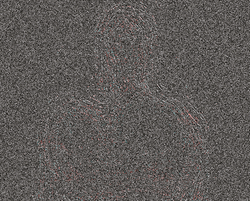
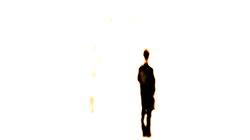
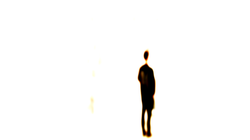
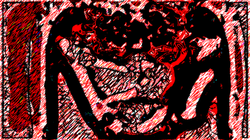
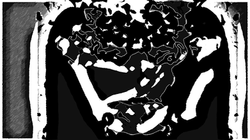
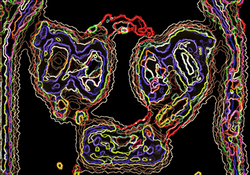
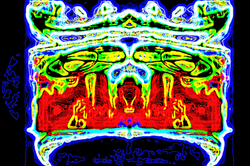
b. Approx. 4 cameras should be placed on the gallery’s ceiling, recording everything that happens in the gallery from opening to closing hours. A screen should hang in front of the ‘floating wall’ built-in advance (only in the case that 'in front' still has any meaning after visitors’ constant re-shaping). All camera pictures would appear on the screen simultaneously, dividing the screen into as many parts as cameras operate at a time. Live and ‘archive’ pictures would run parallel, so past acts would come alive. There would be no long shots since each camera would only record a piece of the gallery space (so the whole location should not be surveilled). Also, time horizons would be slid since live records and ‘archive’ pictures would appear showing different times (and thus represent various states). Cameras cannot take really sharp images in order not to identify anyone on them (partly due to privacy issues), but they would mainly do so in order to avoid further observation of the activities taking place. Only fragmented outlines will be visible.
12. Do not have a classic exhibition opening. Its date should certainly be promoted, and adequate and prominent people must be invited, but the ceremony must be skipped. Do not serve free food or drinks. Competent people from the gallery cannot be present (especially me, the artist-curator). Visitors cannot be given any guidance (there is no one who could do that), so people could only gain information from the cashier and the cloakroom attendant. The gallery should open half an hour prior to the promoted opening time. Sooner or later, everybody would find the location, and all visitors would spend the time at their own discretion.